Software Development
connect.myapp.cafe - Remote Maintenance Solution for Robotic Coffee Bars
Web-based remote maintenance solution for monitoring and controlling MyAppCafé Boxes - autonomous robotic coffee bars that serve fresh coffee drinks. Leverages AWS IoT for real-time job execution and status updates.
Challenge
Create a unified interface to streamline administration tasks by integrating multiple existing services including ERP system, camera feeds, and voucher systems into a single, easy-to-use web application while providing real-time job execution capabilities.
Solution
Developed a modern web application using Svelte 5 with TypeScript, Tailwind CSS for styling, and Docker for containerization. Integrated AWS IoT for real-time remote job execution and status updates, enabling administrators to monitor and control robotic coffee bars in real-time. Implemented comprehensive testing with vitest and CI/CD pipeline with GitHub Actions for automated deployment.
About this project
MyAppCafé operates autonomous robotic coffee bars: self-contained “boxes” in which an industrial robot, coffee machines, food printers, payment and order terminals, and dispensing units produce and hand over beverages without staff on site. The machines run distributed across Germany and the USA, operated by franchisees who are rarely near their box when something needs attention. FxB built connect.myapp.cafe, the remote maintenance portal through which franchisees and service staff monitor and control their machines from any current browser, on desktop or phone, and maintains it in ongoing operation.
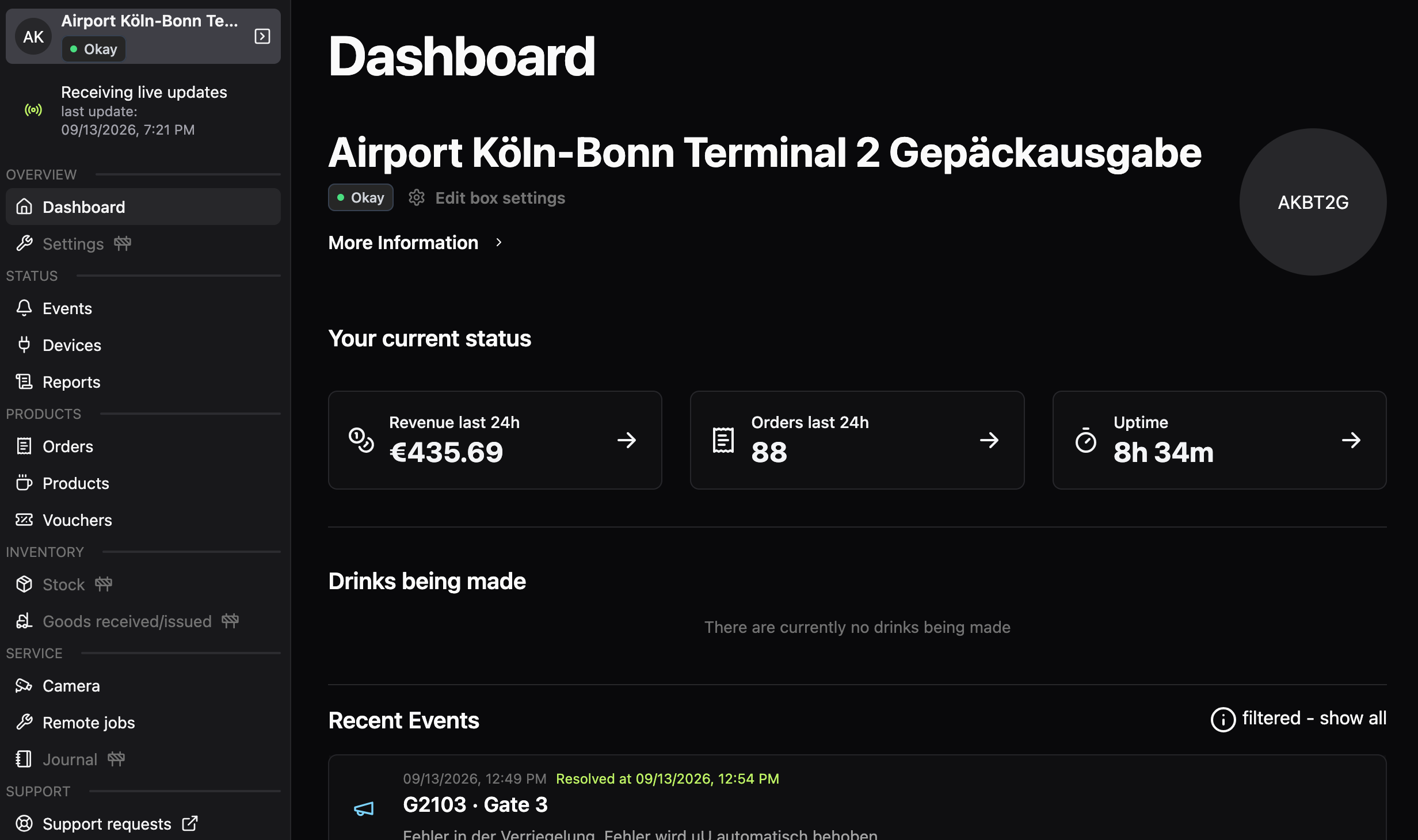
The portal shows the live condition of a box at device level:
- Device status for every installed unit: coffee machines, food printers, payment and order terminals, dispensers, robot, scanners, and cup holders
- Orders currently in production, from queue to pickup
- Events and error messages since the start of the operating day
On top of that sits a catalog of around twenty predefined control tasks: from pausing operation, restarting or deactivating individual devices, and disposing of a stuck cup, through maintenance mode, up to releasing a locked robot, an action reserved for technically trained personnel.
Architecture
Command execution runs over AWS IoT. The portal keeps a permanent connection to the box’s main control software, publishes device and program status, and dispatches every task with:
- defined timeouts per task type
- per-box serialization: one task at a time
- a complete audit trail of who started which task and when
Tasks are gated by machine state: cup disposal, for example, can only be started while production is paused. Device pickers only offer units that can actually execute the selected action, and access follows a role model in which franchisees see their own box and master franchisees the boxes of their region.
A second focus was consolidation. The portal absorbed the functions of the previous franchise portal and several stand-alone tools:
- the ERP module with orders, products, invoices, statistics, and stock levels
- the camera module with live stream and 72-hour lookback
- the voucher system
- a dynamically rendered price board for the in-store displays
A price change made in the portal propagates in real time to the order terminals, the price board, the customer app, and invoicing.
Operation
Reliability was a design requirement, not an afterthought. The service restarts itself daily without affecting production, reconnects automatically after network or power interruptions, and distinguishes between ephemeral progress messages and guaranteed final task results. The stack (Svelte 5 with TypeScript, Tailwind CSS, Docker, vitest, and a CI/CD pipeline on GitHub Actions) was validated against real boxes before rollout. Security updates and critical fixes are covered by an ongoing maintenance agreement.
The result is a portal that shortens downtime and avoids service travel. Operators resolve most incidents remotely, from checking the camera stream and the event list to restarting the affected device, and keep a single, permission-controlled view of their entire fleet. Frontend, cloud infrastructure, and the integration with the control level came from one source.